Amstrad CPC[edit]


Developed and published by Imagine Software in 1987.
Apple II[edit]


Developed and published by Taito Corporation in 1988.
Apple IIgs[edit]

Developed and published by Taito Corporation in 1988. Utilizes the enhanced hardware of the GS to produce a more arcade accurate conversion.
Atari 800/XL/XE[edit]


Developed and published by Imagine Software in 1987 in Europe. One of the latest commercial releases ever published for the system, an ironic contrast to its forebear Super Breakout which was one of the earliest games publish. Also probably the most primitive graphically.
Atari ST[edit]
Developed and published by Imagine Software in 1986 in Europe. Published in the United States by Taito. Extremely accurate.
-
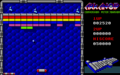
screen
-

American box
-
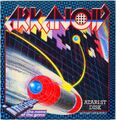
European box


Commodore 64[edit]
Developed by Probe Software and published by Imagine Software in 1987 in the Europe. Published in the United States by Taito.
Provides a few options for the control system, with a choice of a Neos Mouse, Joystick, Keyboard (both Shift keys and space), and paddles. You can only complete the game on one "credit".
-
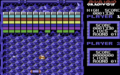
screen
-
American box
-
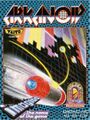
European box

Commodore Amiga[edit]


Developed and published by Discovery Software International in 1987. Besides its high accuracy to the original game, some versions include a second set of 33 boards along with the original, many featuring newely-designed backgrounds not seen in any other version.
Macintosh[edit]


Developed and published by Discovery Software International in 1988. Considered challenging due to its restriction to black and white graphics.
MS-DOS[edit]

Developed by NovaLogic, Inc. and published by Taito in 1988. Developed for CGA and EGA graphic modes.
MSX[edit]


Developed and published by Taito Corporation in 1987 in Japan. Considered similar to the NES conversion, but the power ups don't have letters.
NES[edit]
The Famicom and NES conversion is probably considered one of the most interesting conversion made, for a couple of reasons. First, it contains 3 extra stages exclusive to this version, which appeared before the final confrontation with DOH.
Second, it came packaged with an exclusive controller, one that could only be used for Arkanoid (and Arkanoid 2; only released in Japan). It was a paddle controller with a dial on the bottom and a button at the top. The dial has a fixed rotation, but the small lid to the right could be lifted and you could use a screwdriver to fine tune the output range of the dial. It was a grayish beige in America and mostly black in Japan. Due to its lack of use with any other game, it is considered one of the rarest NES controllers to come by.
There are two codes for the game:
| Stage Select | When a level first appears on the screen, press and hold  and tap or hold and tap or hold  . This will only work up to Stage 16. . This will only work up to Stage 16.
|
|---|---|
| Continue | At the game over screen, press and hold + and press and press  five times. Then release the buttons and press . five times. Then release the buttons and press .
|
-
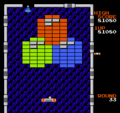
Stage 33
-
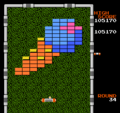
Stage 34
-
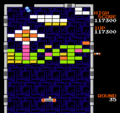
Stage 35


-
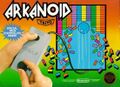
American box
-
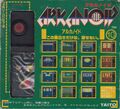
Famicom box
-
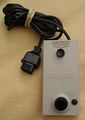
Vaus controller


Sinclair ZX Spectrum[edit]

Developed by Probe Software and published by Imagine Software in 1987.
TRS-80 Color Computer[edit]


Developed by Taito and published by the Tandy Corporation in 1989. Developed with a lower resolution mode for users of the CoCo 1 or 2, and a higher resolution mode with more accurate colors for users of the CoCo 3.