Pac-Man has an interesting "family tree", having had sequels developed by four different companies in three different countries (Pac-Attack & Pac-In-Time had also been rebranded from other games).
Ms. Pac-Man: Originally developed by General Computer Corporation as an enhancement kit named "Crazy Otto", and released by Bally Midway in 1981 without Namco's permission. The rights to the title now belong to Namco, as Bally Midway turned it over to them after a year to appease them.
Mr. & Mrs. Pac-Man: Developed by Bally Midway's pinball division and released in 1982. This title is strictly a pinball game but the centre of its table contains a small mini "video" game in which the player must light up twenty-five dots while avoiding a red one that represents Blinky (the red ghost).
Super Pac-Man: Developed by Namco and released in 1982 as the first official sequel to Pac-Man. Featured gates which Pac-Man had to unlock by eating keys (along with super pellets that temporarily tripled his size and made him invulnerable to the ghosts when they were their normal colours).
Pac-Man Plus: Developed by Bally Midway and released in 1982 in an attempt to compete with unauthorized bootleg versions of Pac-Man that were appearing in the market, as it featured several random events activated when Pac-Man ate a power pellet or a bonus item. Unauthorized by Namco.
Baby Pac-Man: One of only three videogame/pinball hybrids ever made, developed by Bally Midway and released in 1982. Unauthorized by Namco.
Jr. Pac-Man: Developed by General Computer Corporation and released by Bally Midway in 1983 without Namco's permission. Its mazes were twice the width of the cabinet's monitor and scrolled horizontally to keep up with the player (it was also possible for the ghosts to be off-screen sometimes).
Pac & Pal: Developed by Namco and released in 1983 as the third official game in the Pac-Man series. The American release would have been titled "Pac-Man & Chomp Chomp", due to the fact that it replaced Miru (the title's "Pal") with Chomp-Chomp (Pac-Man's dog from the Hanna-Barbera Pac-Man cartoon series, which was premiered on ABC from 1982-1983), but Bally Midway either passed up the rights, or they were not offered the rights.
Professor Pac-Man: Developed by Bally Midway and released in 1983 without Namco's permission. Unlike all of the previous titles, it was a multiple-choice quiz game, and there were originally three versions of it planned, but it was almost an immediate flop and most operators only had it hanging around for as long as it took to get it shipped back to the distributor. Only 400 cabinets of it were ever made and they were all of the "Public" variety.
Pac-Land: Developed by Namco and released in 1984. One of the first sidescrolling platform games ever made (appeared before Super Mario Bros. was released on the NES). The last title to be distributed in the United States by Bally Midway before Namco terminated their partnership with them.
Pac-Man 2: The New Adventures: Developed by Namco and released in 1994 for the SNES and Sega Genesis, the player does not have any direct control over Pac-Man in this game, but rather interacts with him by firing rocks at objects in his environment in an attempt to help him solve puzzles.
Pac-In-Time: Developed by Atreid Concept S.A. and Kalisto Entertainment as a rebranding of their own Fury of the Furries, and released by Namco for the Game Boy and SNES in 1994. A return to traditional platform mechanics, allowing Pac-Man to jump, and even use a grappling hook to reach new destinations and collect all of the pellets in each level in order to open the exit. Pac-Man is also given the uncharacteristic ability to spit fireballs.
Pac-Mania: Developed by Namco and released in 1987. Presented with a pseudo-3D isometric view, Pac-Man is granted the ability to jump over his ghostly foes, but the game's two newly-introduced ghosts, Funky (green) and Spunky (gray), can also jump at the same time as him in the Sandbox Land and Jungly Steps worlds (the latter is also impossible for Pac-Man to jump over in both those worlds). Distributed in the United States by Atari.
Pac-Man Arrangement: Developed by Namco and originally released in 1996 as part of the compilation Namco Classics Collection Vol. 2. Returns to a more traditional view point, but with enhanced graphics and additional game elements such as a new sunglasses-wearing ghost, Kinky (dark blue).
Pac-Man Vs.: Developed in 2003 by Nintendo's Shigeru Miyamoto exclusively for the Nintendo GameCube. This game allows for one player to use a connected Game Boy Advance system to control Pac-Man, while up to three other players use the TV to control up to three of the four ghosts Blinky, Pinky (pink), Inky (light blue) and Funky having only a limited perspective of the maze. Though Pac-Man has the advantage of unlimited visibility, the other players can team up to outsmart him (and the ghost-controlling player who catches him is the next to control him with the Game Boy Advance).
Pac-Man Championship Edition (パックマン・チャンピオンシップエディション,Pakkuman Chanpionshippu Edishon?), sometimes only referred to as "Pac-Man C.E.", is the latest Pac-Man game, released in 2007, developed by original Pac-Man creator Tōru Iwatani, exclusively for the Xbox Live Arcade.
Pac-Attack: Developed by Namco and released for the SNES, Sega Genesis, Game Boy and Game Gear in 1993 as a rebranding of their own 1992 arcade game Cosmo Gang: The Puzzle, itself also converted for the SNES. Elements of this Tetris-like game were altered to fit the Pac-Man theme.
Pac-Man World: Developed by the American branch of Namco for the PlayStation and released in 1999. A platform game presented primarily in a 3D side-scrolling view. In this game, Pinky's gender was changed to female, but he stayed male for Genie's unofficial sequel Puckman Pockimon (2000).
Ms. Pac-Man Maze Madness: Developed by the American branch of Namco for the PlayStation, and released in 2000. Gameplay for this title, which was the first one that focused exclusively on Ms. Pac-Man since her self-titled game, was similar in style to Pac-Man World, but more maze-focused.
Pac-Man World 2: Developed by the American branch of Namco for the Nintendo GameCube, Game Boy Advance, Xbox and PlayStation 2 in 2002. The gameplay for this title was more free-roaming 3D than the first Pac-Man World (it also featured conversions of four of the earlier titles as extras).
Pac-Man World 3: Developed by the American branch of Namco for the Nintendo GameCube, Xbox, PlayStation 2 and PlayStation Portable in 2005. More of the same as Pac-Man World 2 with several improvements (a Game Boy Advance version for this title was also planned, but later cancelled).
Pac-Man World Rally: Developed by the American branch of Bandai-Namco for the Nintendo GameCube, PlayStation 2, and PlayStation Portable in 2006. This Super Mario Kart-style kart-racing clone also featured characters from other Namco franchises, including Dig Dug, Mappy and Mr. Driller.
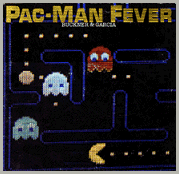
Original 1982 Pac-Man Fever album cover, 45RPM version.
Pac-Man Fever is a 1982 album recorded by Buckner & Garcia. It is also the name of the first song on that album. Each song on the album is about a different classic arcade game, and uses sound effects from that game. The album was released as an LP, a cassette, and as an 8-track tape. As of 2002, the name is also referring to a party game that was released by Namco on both the Nintendo GameCube and PlayStation 2.