
This is the first game in the Rally-X series. For other games in the series see the Rally-X category.

| Rally-X | |
|---|---|
| Developer(s) | Namco |
| Publisher(s) | Namco, Midway Games |
| Year released | 1980 |
| System(s) | Arcade, MSX, Fujitsu FM-7, Commodore VIC-20, Sharp X1 |
| Followed by | New Rally-X |
| Series | Rally-X, Arcade Archives |
| Japanese title | ラリーX |
|---|---|
| Genre(s) | Action |
| Players | 1-2 |
| Modes | Single player, Multiplayer |
| Arcade Archives Rally-X | |
|---|---|
| Developer(s) | Namco |
| Publisher(s) | Hamster Corporation |
| Year released | 2021 |
| System(s) | Nintendo Switch, PlayStation 4 |
| Rating(s) |     |


Rally-X is a title that is more of a footnote in Namco arcade history, having been eclipsed not only by its own sequel New Rally-X (which was released in the following year), but also by another fellow 1980 Namco title, Pac-Man. Rally-X is quite a fun game, it just does not stand out as well as some of its competition. You play the role of a driver who must navigate through a zoomed-in view of a set of city streets, attempting to collect all ten flags in the stage while avoiding the red enemy cars and rocks. Simple in premise, difficult in practice. It was also the first game from Namco to use a horizontal monitor, and one of only three pre-M6809 Namco games whose score did not roll over at 1,000,000 - the other two were the aforementioned New Rally-X, and Bosconian.
When Rally-X was shown at the 1980 Amusement Machine Operators of America (or A.M.O.A.), it appeared alongside titles such as Pac-Man and Defender. The marketing experts at the show all declared that Rally-X would be more successful than either of the other two games. They couldn't have been more wrong. As a result, Rally-X didn't gain much notoriety, especially outside of Japan. It appeared on the MSX and FM-7 home computer systems, and would not be seen again until it was included in Namco Museum Vol. 1 in 1995 for the Sony PlayStation. In an effort to address the complaints that Namco received about their game's difficulty, they released the better balanced New Rally-X in 1981, which performed much better. Rally-X's lasting legacy was the introduction of a yellow special flag, which would reappear in later Namco games such as Xevious, Libble Rabble and Gaplus.
-

Logo.
-
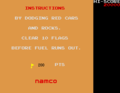
Title screen.
-
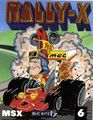
The MSX version's cover art.


Controls[edit]
- Joystick: Press the joystick to direct the car in the four cardinal directions that you would like the car to go. The car will never stop moving, and will automatically turn when it hits a wall. You can hold the joystick down in a new direction in anticipation of a turn. The car will even lean in to either side of the wall it brushes against to indicate that the turn will be performed.
- Smokescreen: Press the button to release three puffs of smoke behind your car. Enemy cars that run into this smoke will be stunned and unable to continue along the path that they were driving along. While this can be a life saver in close situations, using the smokescreen substantially reduces the amount of fuel you have. Using smokescreen more than once every thirty seconds will almost ensure that you will run out of gas before all ten flags are captured - and when this happens, your car will slow down and its smokescreen will cease.
- 1 or 2 Player Buttons: Push these buttons to begin a one or two player game.
Characters[edit]
Player car[edit]

This is your car, the one that you must drive around the stage in order to collect every flag. Your car may not be as fast as the red enemy cars, but it can turn around corners faster. Your car also has one secret weapon against the enemy: smokescreen. But beware, using smokescreen burns fuel much faster than normal. Should your car run out of fuel, it will slow down to a point where escape from the enemy is impossible. One collision with an enemy car or rock will destroy your car, and you will lose one life.
Enemy cars[edit]

Enemy cars start out directly beneath your starting position. More get added as you reach higher levels, and eventually enemy cars are added to the stage at the very top of the map. They are faster than your car in a straightaway, and their drivers will attempt to collide by taking the quickest path that they can find. However, they're not as bright as you, and they are easy to fool. They won't make a 180 degree turn unless they have absolutely no choice. Driving into your smokescreen, a rock, or another enemy car won't eliminate them from the game, but it will stun them for a second or two (indicated by them spinning around), giving you a chance to put some distance between you.
Flags[edit]


There are ten flags in every stage. You must collect all ten of them to advance to the next stage. The first flag is worth 100 points, the second is 200, and so on until you collect the tenth flag for 1000 points. The points awarded will reset back to 100 if you lose a life and start the stage over. One flag out of the ten is a special flag, and it is indicated by the letter "S" to its left side (as you can see in the image to the right). By picking it up, the score that you receive for each flag thereafter doubles.
Rocks[edit]

Simply put, rocks are a danger to your car. If you run into one, it will cost you one life. But if the enemy cars run into one, they will merely become stunned just as they do when they run into your smokescreen or each other. Their positions are also not indicated on the radar on the right side of the monitor, so you need to be careful.
How to play[edit]

- Your only goal is to collect all ten flags as quickly as possible. You need to pay constant attention to two things: the zoomed-in view of the world that occupies the left side and most of the centre of the monitor, and the radar view of the world on the right.
- The radar view provides you with two key pieces of information: the relative position of the flags in the world (indicated by the yellow dots), and the proximity of the enemy cars (indicated by the red dots) to yours (indicated by the black-white flashing dot).
- The method you use for collecting the flags is of utmost importance. It is usually best to try to hop from one flag to whichever flag is closest, but the enemies will make that quite difficult to do. As a general rule, you should not reverse your direction unless it is absolutely necessary and completely safe to do so (i.e. when there are no enemy cars behind you, as this will otherwise kill you).
- If you have to choose between getting close to an enemy car to pick up a nearby flag, and abandoning that flag for a farther flag, you should go for the farther flag. The more distance you put between you and the enemy cars, the safer you will remain in this.
- In general, you will be safe off if you choose a direction to collect flags, clockwise or counter-clockwise, and stick to it throughout the duration of the stage. However, this technique cannot be relied on in the later stages when more enemy cars start at the top.
- The smokescreen is an invaluable and incredibly tempting tool to use. But if you use it too much, you will deplete your fuel supply very quickly, making it more likely that you will run out of fuel before you collect all 10 flags, which will almost ensure your demise.
- Challenge levels (spelled "CHARANGING STAGE" by the game) occur before each stage change, which occurs upon the third stage and every fourth stage thereafter. In these stages, you are free to collect all of the flags without being harassed by enemy cars until your fuel runs out. However, you can still crash into parked cars and rocks, so you must still be careful.
Trophies[edit]

| |||
|---|---|---|---|
| 6 | |||

|

|

|

|
| 1 | 3 | 2 | 
|


There are six trophies for PlayStation 4.
| Picture | Name | Description | Trophy |
|---|---|---|---|
 |
Record score | The score has been posted to the online rankings in the "ORIGINAL MODE". | Silver
|
 |
Mark high score | High score has been updated. | Silver
|
 |
Score 30,000 points | The score won 30,000 points. | Bronze
|
 |
Score 70,000 points | The score won 70,000 points. | Silver
|
 |
Score 120,000 points | The score won 120,000 points. | Gold
|
 |
HI SCORE Player | The score has been posted to the online rankings in the "HI SCORE MODE". | Gold
|