Amstrad CPC[edit]


Developed by Binary Design and published by Virgin Masteronic in 1988. The graphics are blocky, and the player characters both have the same color, except Jimmy is a slightly lighter color.
Atari 2600[edit]


Devoloped by Imagineering and published by Activision in 1989. Limited capicity graphics, repetetive music, and very hard controls with only one button. All of the enemy characters, except for Linda, Abobo and Willy, are palette-swaps of the main characters. Marian is a reuse of Linda's sprite. The weapons you get are knife (white stick), bat (brown stick), and an oil drum.
Atari 7800[edit]


Devoloped by Imagineering and published by Activision in 1989. Graphics are a bit weaker than NES and Master System versions, and has same music as the 2600 version. All of the enemy characters, except for Linda, Abobo and Willy, are palette-swaps of the main characters. Marian is a palette-swap of Linda's sprite. The only weapons you get are a knife, bat, and a whip.
Atari Lynx[edit]


Developed by Knight Technologies and published by Telegames in 1993. Graphics are taken straight from the Genesis version, but the only enemy characters featured are Williams, Linda, Abobo and Willy. The game is 1-Player only. The weapons you get are bat, knife, box, rock, and whip.
Atari ST[edit]


Developed by Binary Design and published Melbourne House in 1988. All the enemies except Abobo and Linda are palette-swaps of the main characters.
Commodore Amiga[edit]


Developed by Binary Design and published Melbourne House in 1988. All the enemies except Abobo and Linda are palette-swaps of the main characters.
Commodore 64[edit]


Developed by Binary Design and published by Melbourne House in 1988, and by Ocean in 1991. There are 2 versions. The US version has all the characters in the same size, while the UK version has only 1 player. The US version has lacked Jeff, while the UK version lacked Linda, Jeff, and Willy. The weapons in the US version are bat and a whip, while the UK version has only a bat.
The UK version is simplistic, having one player fight the way through various enemies. It uses a three lives system (where losing a life just causes a few seconds of invincibility, and falling down when health is drained at life 0), and a three credit system. The basic attacks include a punch when standing still, and a headbutt when moving. Jumping is performed by pressing space.

The US version, containing 6 missions, gives the player a wider variety of attacks compared to the UK version. It also contains a glitch to immobilize enemies - when enemies is following you, move to the top of the fighting area, then jump over them. In a two player game, the other player can attack immobilized enemies without retaliation.
Game Boy[edit]
Developed by Technos and published outside Japan by Tradewest in 1990. The game is based on the NES version, but the level designs are different again. Unlike the NES version, the player has all of their moves from the start. Some of the enemies gain new techniques. Like the NES version, it lacks 2-Player co-op, but has a head-to-head versus mode where one player can compete against another via link cable, although only Billy/Jimmy is playable in this version's versus mode.
MSX[edit]


Developed by Zemina in 1989. Has all the stages from the NES version. No Linda, Jeff, and Willy. The only weapon you get is the knife.
NES[edit]
- For NES version, see Double Dragon (NES).
PC (MS-DOS)[edit]


Developed by Arcadia in 1988. The CGA graphics has pink, light blue, and white; while the EGA graphics have nearly all the colors from the arcade version. The weapons you get are bat, whip, knife, and box.
Sega Genesis[edit]


Developed by Accolade and published by Ballistic in 1992. The graphics are almost similar to the arcade version, but the characters and backgrounds have tweaked a bit. Jick is missing in this version, replaced by Abobo in all of his appearances, while Jeff is a palette swap of the Lee brothers.
Sega Master System[edit]
Developed by Arc System Works and published by Sega in 1988. The graphics are similar to the NES version, but has level designs similar to the arcade version.
-
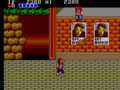
Screenshot
-
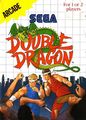
American/European box art
-
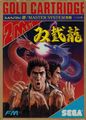
Japanese box art


Xbox Live Arcade[edit]


An Xbox Live Arcade version of Double Dragon for the Xbox 360 was released on May 9, 2007. This version features an emulation of the original arcade game, as well as an optional game mode featuring redrawn high definition graphics and a remixed soundtrack. It also features support for online multiplayer. It was delisted on July 1, 2009 due to the closure of its publisher, Empire Interactive.
Zeebo[edit]
An remake version by TecToy exclusive for Zeebo and released only in Brazil.
ZX Spectrum[edit]


Developed by Binary Design and Melbourne House in 1988. While the Spectrum could only display a very few colors at a time (one of which was almost always black) it features large and detailed graphics, considering this limitation. The 48k uses beeps and bloops while the 128k uses all the music from the arcade version. The weapons you get are bat, knife, rock, oil drum, and a whip.