
Archives
Welcome to all users! This page is where you can ask StrategyWiki-related questions to the staff and senior community figures, and they will do their best to answer. New issues are entered here, with the most recent at the bottom of the page. If your question does not pertain to editing StrategyWiki (e.g. asking for hints or game-specific information), please ask on the guide's talk page or on the forums.
Please review the Table of Contents to see if your issue has already been raised; also check the archives (to the right) in case it was discussed some time ago.
To facilitate ease of browsing and replying, please:
- Place your question at the bottom of the list.
- Title the question (by placing the title between equals signs: ==Title==).
- Sign your name and date (by adding four tildes: ~~~~).
Backward compatibility[edit]
Currently, there is a consideration to add all platforms that a game is playable on to its infobox. This includes platforms that offer backward compatibility (for example, all PS4 games can be purchased on the PS5's digital storefront, even though those games were not made for the PS5). The question then becomes how to handle this for platforms that offer limited backward compatibility (for example, the original DS and DS Lite models could play all GBA games, but this feature was discontinued with the DSi). Any thoughts? --WarioTalk 19:01, 7 May 2021 (UTC)
- I think we should cover this information, but with BC being inconsistent, we would need some kind of clarification. I think the easiest solution is a template like {{bc|ps5}} in the infobox, which links to the
#Backwards compatibilitysection on the relevant system's page, which can go into how BC is supported on that system. The infobox could look something like this: |systems=[[PlayStation 2]], {{bc|ps3}}- A related question would be purpose-built backwards compatibility like Super Game Boy, which allows you to play GB games on SNES. I think it supports everything that Game Boy supports, but some games have "special features", like special borders and colour schemes. Would these count as supported systems, or BC? -- Prod (talk) 19:42, 7 May 2021 (UTC)
- Still hoping to get more feedback on this one. -- Prod (talk) 00:22, 12 September 2021 (UTC)
- Now with {{syslist}}, perhaps we can have {{bclist}}? -- Prod (talk) 23:06, 30 July 2022 (UTC)
- I'm thinking the best course of action is probably having a
|bcsystems=parameter in the infobox with a {{bcsyslist}} template. This way we can modify the layout in the future (either show it with the systems, or as a separate row), and we can have more unique categorization options for each system. -- Prod (talk) 02:41, 8 August 2022 (UTC)
- Still hoping to get more feedback on this one. -- Prod (talk) 00:22, 12 September 2021 (UTC)
- I think splitting them to two groups is fine. I would not treat hardware extensions like SGB the same as I would say the Wii playing GCN games. Trig - 17:11, 23 March 2023 (UTC)
A topic that came up on discord yesterday was the Wii Virtual Console situation where games were sold on new platforms, but using emulation. In particular the fact that without the category the main Wii category is filled with irrelevant entries. My opinion is that it was a mistake to remove the category, it is needed to keep the main system category free of clutter.--Henke37 (talk) 17:53, 23 March 2023 (UTC)
Multiplayer[edit]
This category should be split up into more specific categories. At least the following:
- Local multiplayer
- Local co-op
- Local splitscreen multiplayer
- Local hotseat multiplayer
- Online multiplayer
- Online co-op
- MMO
Any others? -- Prod (talk) 17:29, 28 July 2022 (UTC)
- Local splitscreen co-op, and maybe instead of "multiplayer" it should be "versus" or "PVP". Also it would be good to have a modelist template. -BrownDerby (talk) 19:21, 28 July 2022 (UTC)
- I'm still a bit concerned about the "co-op" term at all. It's really useful to know which games have a co-op mode, but a game has to have multiplayer in some form to allow it, so I'm not sure it exactly fits in with all the other options. Perhaps it should only be a single option that says "yes there is some form of multiplayer co-op".
- Single player
- Email multiplayer (Civilization)
- Multiplayer (Contra)
- Hot-seat multiplayer (Super Mario World)
- Split-screen multiplayer (GoldenEye 007)
- Online multiplayer
- Massively multiplayer online
- Co-op
- -- Prod (talk) 20:24, 28 July 2022 (UTC)
- Going by this list, it looks like the "coop" designation is orthogonal to the rest. Coop describes the relationship between players, while the rest are how two players share the experience.--Henke37 (talk) 08:12, 11 August 2022 (UTC)
- Being orthogonal, we could either create categories for every intersection (with multiplayer, so 13 total) or keep it as a separate entry and people could search based on some kind of query (DPL or Cargo). I feel these 8 categories should be enough of a split for most purposes, or is it over-categorization already? -- Prod (talk) 22:51, 23 March 2023 (UTC)
- Going by this list, it looks like the "coop" designation is orthogonal to the rest. Coop describes the relationship between players, while the rest are how two players share the experience.--Henke37 (talk) 08:12, 11 August 2022 (UTC)
- I'm still a bit concerned about the "co-op" term at all. It's really useful to know which games have a co-op mode, but a game has to have multiplayer in some form to allow it, so I'm not sure it exactly fits in with all the other options. Perhaps it should only be a single option that says "yes there is some form of multiplayer co-op".
Delete all Days[edit]
As the various {{rd}} based templates are disappearing, nothing will be categorized by the days of the year. It makes sense to delete all the day sub-categories like January 1. This leaves the redirects, like January 1. Simplest would be to delink and delete them all. Does anyone see any potential uses for these pages otherwise? -- Prod (talk) 00:09, 10 August 2022 (UTC)
- Honestly no, these categories rarely helped unless someone wanted to know what games were released on their birthday. I did wonder if a month/year category would be interesting, but probably only for people who religiously chronogame like I do, and I have other sources for that information. I say let 'em go. Procyon 01:07, 11 August 2022 (UTC)
- I agree with the end of days. I think keep things in months as the smallest is fine. As for day pages, with the exception of April 1st which may have inter-site function (and should exclusively be used for that), games should not have listed days as links. Trig - 17:11, 23 March 2023 (UTC)
- If you mean Category:March, I feel that's unnecessary since it doesn't really serve a purpose. If you mean at the year-specific level, like Category:March 2023, I feel it gets back to the original problem of us having verified data on specific months. Users shouldn't come to us as a source for release dates, even at a monthly level, the primary use of dates, since none of it is verified. -- Prod (talk) 22:22, 23 March 2023 (UTC)
- I agree with the end of days. I think keep things in months as the smallest is fine. As for day pages, with the exception of April 1st which may have inter-site function (and should exclusively be used for that), games should not have listed days as links. Trig - 17:11, 23 March 2023 (UTC)
- This is now done. -- Prod (talk) 06:59, 23 April 2023 (UTC)
Fully gut supporting unplayable games[edit]
It does not make sense that we host coverage of games that are no longer playable in any capacity. Many of these guides were not even well completed either. I would like to nominate the deletion of all to most existing unplayable titles, and implementing a policy that would remove game that have shut down or recently become unplayable otherwise to be deleted after 1 month of its closure. Trig - 17:11, 23 March 2023 (UTC)
- We should absolutely keep the front pages. The games existed, and we should show that we know of their (one-time) existence. I can see validity to discussing purging all subpages, but some of these games do come back as abandonware. -- Prod (talk) 22:55, 23 March 2023 (UTC)
- And if they do, the main page can be undeleted. Nonexistant/unplayable titles are for Wikipedia, not StrategyWiki. Trig - 02:29, 24 March 2023 (UTC)
- Bumping this conversation. Since then, I have also added several more titles to the list that weren't initially marked for unplayability. Trig - 13:10, 18 April 2023 (UTC)
- Maybe it'd be better to have just made a new section, but I remain firm that we should remove these titles and they are not applicable to our scope. Trig - 05:20, 18 January 2024 (UTC)
- Bumping this conversation. Since then, I have also added several more titles to the list that weren't initially marked for unplayability. Trig - 13:10, 18 April 2023 (UTC)
- And if they do, the main page can be undeleted. Nonexistant/unplayable titles are for Wikipedia, not StrategyWiki. Trig - 02:29, 24 March 2023 (UTC)
Virtual Console[edit]
A discussion was had recently in the Discord about Virtual Console. To be more clear, in a categorical sense, games that were purchasable via Nintendo's Virtual Console should not list the console purchased on a game's infobox. An example is Albert Odyssey (1993), which while playable via the Super Famicom and Satellaview, were also able to be downloaded on the Japanese Virtual Consoles for Wii and Wii U. These Virtual Console releases are simply emulation, so I believe a consensus should be reached on whether the modern consoles names are completely removed, kept on there, or if a new category for Virtual Consoles should be added. Auxillify (talk) 22:01, 23 March 2023 (UTC)
- Wii VC and similar were all removed since they're more like distributors than systems. You still play the game on your Wii system, though it is emulated (officially provided by the manufacturer, rather than 3rd party). There's a lot of systems that would need to be (re)created to re-categorize like this, and I'm not sure they're all as simple as running through an emulator.
- One idea brought up on discord was to handle these like the Super Game Boy. Categorize them, but don't list them in the infobox. They're similar to accessories to the base system that provide additional functionality (playing old games). -- Prod (talk) 23:14, 23 March 2023 (UTC)
- I think VC should be identified as a sales platform and not a system, similar to Steam. Steam isn't a system, it's a distribution point. (To complicate matters more, we don't identify Steam games as belonging to the PC system, we say they're Windows and/or Linux games). We used to have this distinction in the Infobox but then it went away. I think it's a useful distinction, and I'd be in favor of bringing it back. Yeah it can become a headache to maintain all of the sources where a game can come from, but that's the point of the wiki; it's a collaborative effort, and it can be achieved through enough users' efforts. Procyon 00:51, 24 March 2023 (UTC)
Mods are Asleep[edit]
Write klondike walkthroughs. --45.72.205.4 04:17, 1 April 2023 (UTC)

Syscat/data.json[edit]
"360" for Xbox 360 doesn't work. -BrownDerby (talk) 04:25, 18 April 2023 (UTC)
- I believe this should be fixed now. Thanks for bringing it up! -- Prod (talk) 05:37, 18 April 2023 (UTC)
Please add "pv1000" and "pv2000" for Casio PV-1000 and Casio PV-2000. -BrownDerby (talk) 21:30, 2 April 2024 (UTC)
pokemon red generation 1 online trading[edit]
I recently started playing Pokémon generation 1 - red, and i wanted to know if there is any way I can trade online to complete pokedex? thank you! Bentho (talk) 06:18, 23 April 2023 (UTC)bentho
- This really isn't an area of expertise for StrategyWiki. It's unclear by what method you are attempting to do this, but regardless, you would be better served posting this question to the r/pokemon subreddit on Reddit, as they are more likely to know the answer to your question. Procyon 02:56, 24 April 2023 (UTC)
Image Category updates[edit]
Category:Company logos and Category:System logos are currently in Category:Logos Category:Logos directly seems to contain a mix of series and game-specific logos (mobile games).
I'd like to suggest we get rid of Category:Logos, and split it into the following 4 categories:
-- Prod (talk) 19:30, 11 May 2023 (UTC)
- I retort with have all five. There will always be outliers and exceptions, plus it makes sense to have a unifying root category anyway. Logos/Game logos/Series logos/Company logos/System logos. Trig Jegman - 20:32, 11 May 2023 (UTC)
RetroAchievements inclusion[edit]
So, since RetroAchievements is a way to enjoy even more RetroGames, and that people on RA would be looking for guides of Retro games, why not include and add achievements/achievements guides to the related games pages?
Arkhane (talk) 18:54, 26 July 2023 (UTC)
Policy on WebP images?[edit]
I notice that the policy on image formats does not mention WebP. I assume PNGs are currently preferred over WebP for lossless raster images, correct? Iridium Context (talk) 16:28, 4 November 2023 (UTC)
- It's generally better to stick to the original format an image is available in. I believe webp uploads are allowed, so if the image comes in that format it should be fine. It would be better not to convert to webp as it doesn't have as widespread support as the other formats. -- Prod (talk) 22:08, 25 November 2023 (UTC)
Proper image classification for sprites masquerading as 3D models?[edit]
Skaphander: Der Auftrag treats enemies and items as points (not polygonal models) in the 3D scene and renders them as distance-scaled sprites at the appropriate place in the Z order. For example, see this screenshot, where the viruses look like 3D models to try to blend in with the rest of the scene (which is true 3D), but if you look closely, they're actually both the same sprite just at different scales. Is "sprite" still the correct image type to use for uploads even if these are not sprites used in the traditional sense? Iridium Context (talk) 16:29, 4 November 2023 (UTC)
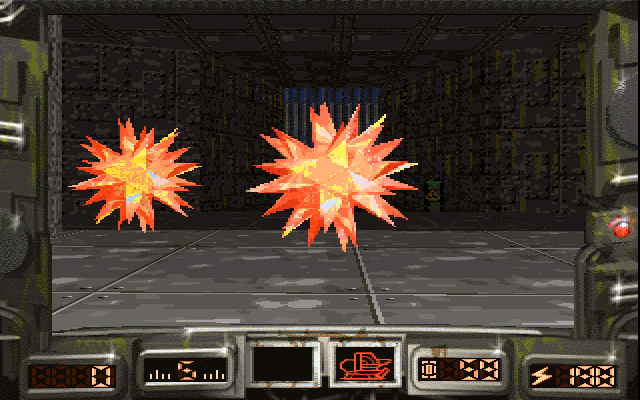
- I would say they probably qualify still as sprites, yes. Trig Jegman - 19:32, 4 November 2023 (UTC)
Content variation by difficulty level?[edit]
At Skaphander: Der Auftrag I was thinking it would be nice to vary the walkthrough text and images by difficulty level, a lot like is done with {{Control selector}} and {{Control}} for different platforms, rather than constantly having to describe three possible cases (easy, medium, and hard) in the prose. However, those templates rely on MediaWiki:Gadget-ControlSelector.js to function. I could abuse it, making templates that provide a controller selector reskinned to look like a difficulty selector, but that wouldn't work if some hypothetical game wants to vary page content by both platform and difficulty level. Would StrategyWiki be open to having a new JavaScript gadget to support a {{Difficulty selector}}/{{Difficulty}} pair that plays nicely with the controls templates? I would be willing to write the JavaScript, and I would keep it short and readable so that it could be reviewed to allay any security concerns. Iridium Context (talk) 15:13, 18 November 2023 (UTC)
- I'm not a fan of hiding content with js. With controls, it's not a big deal for someone to figure out an associated control if the wrong one is showing. But with walkthrough content, it could be frustrating if someone didn't notice the selector switch. Depending on how different the difficulty variations are, it could be simpler to just have sidebars to explain the differences (small changes), separate different sections on each page (large changes), or even separate pages for each difficulty (extensive changes). -- Prod (talk) 22:12, 25 November 2023 (UTC)
Attribute anonymous edit[edit]
Hi there, I just made an edit but forgot to log in. Is there any chance it could be linked to my username instead of the IP? The edit was at Battlefield 3/Table of Contents. Thank you. Hypolar (talk) 17:39, 24 November 2023 (UTC)
- Unfortunately, it's not really straightforward to re-attribute edits. If you're concerned about the IP being visible, we can hide the IP. -- Prod (talk) 22:14, 25 November 2023 (UTC)
SVG, Motion Control, Mouse 4 & 5, PS Vita, and Steam button icons[edit]
- I'd like to have the button icons to be in SVG file format because it is less blurry than PNG or JPG.
- The Wii button template only has a shake icon for the Wii Remote, but there needs to be more motion control icons like tilt, thrust, and shake for each template that supports motion controls.
- There are two mouse buttons on the side known as "Mouse 4" and "Mouse 5". It would be nice to include those two buttons in the mouse template.
- I already did the L & R PlayStation buttons, but all I need next is the Rear Touch Pad on the PS Vita.
- Valve's games' controls are different on Steam Controller and Steam Deck from their console versions, so it would be nice to include Steam Controller and Steam Deck button icons.
Gorilli09 (talk) 11:14, 18 January 2024 (UTC)
- Great. When you find any, let us know and we'll import them.
- Again, find a good source for them and we'll import them.
- What games use a 4th and 5th mouse button? And how would you even represent them?
- Find a model for what a rear touch pad icon should look like.
- What's unique about Steam Deck and Steam Controllers that an X-Box One controller doesn't have?
- This stuff doesn't appear out of thin air. Someone would actually have to make all of this, and I'm a little uncertain as to how useful they would be under general circumstances. Procyon 01:41, 18 January 2024 (UTC)
- I have a set of icons for the Steam Deck that I'll upload when I can get around to them. I do have icon sets for PS3/PS4/PS5/Vita, but they have different colour schemes between them, and are very different from all our other styles. They're also all PNG. -- Prod (talk) 03:54, 18 January 2024 (UTC)
Launchbox Images[edit]
Hello! Just wanted to ask a question regarding images from LaunchBox Games Database. Are they off-limits? Can I use specific ones? Please let me know. Thank you for your time. GamingBound (talk) 13:13, 15 February 2024 (UTC)
Suggestion: Steam link in game infobox[edit]
E.G. |steam=2731870 would link to this. This could also automatically link to PCGW. -BrownDerby (talk) 17:00, 19 February 2024 (UTC)
- I've avoided linking steam directly since I'd rather leave it to users to figure out how to procure their games, without promoting a specific storefront. Steam is the largest online game store, and is generally just a search away, so I don't think the additional effort from editors would help users as much. One thing I've been considering is linking to archive.org's archives of some of the very old games that are much harder to find these days, which are playable online (example). I've been tempted to remove
TwitterX (28 uses) due to recent changes on the platform, and re-assessing twitch (37 uses)/fb (18 uses) as well. - I'd be much more inclined to link to wikidata though, which should be available for all games, not just PC. They currently link to almost 3k of our guides, so it wouldn't be too hard to have a bot connect those up. However, most of those are from PCGW already. -- Prod (talk) 01:27, 29 February 2024 (UTC)
Creating too many articles at a time[edit]
I'm getting concerned about getting banned on the website, because I created too many articles at a time. Is this a problem? Gorilli09 (talk) 15:44, 26 March 2024 (UTC)
- What matters is not quantity, but quality. And we are lenient on good faith edits.--Henke37 (talk)
- Your edits are positive, so low chance of being banned. However, if you could fill in the main pages a bit, that would be appreciated. Just a few sentences about the release (contents of the infobox in sentence form) and maybe a paragraph of what gameplay is like would help a lot. -- Prod (talk) 20:52, 26 March 2024 (UTC)