
This is the first game in the Dragon Buster series. For other games in the series see the Dragon Buster category.

| Dragon Buster | |
|---|---|
| Developer(s) | Namco |
| Publisher(s) | Namco |
| Year released | 1984 |
| System(s) | Arcade, NES, Fujitsu FM-7, NEC PC-9801, Sharp X68000, Sharp X1, MSX2, Wii |
| Followed by | Dragon Buster II: Yami no Fuuin |
| Series | Dragon Buster, Arcade Archives |
| Japanese title | ドラゴンバスター |
|---|---|
| Genre(s) | Adventure |
| Players | 1-2 |
| Modes | Single player, multiplayer |
| Rating(s) |  |
| Arcade Archives Dragon Buster | |
|---|---|
| Developer(s) | Namco |
| Publisher(s) | Hamster Corporation |
| Year released | 2021 |
| System(s) | Nintendo Switch, PlayStation 4 |
| Rating(s) |    |


Dragon Buster is an arcade game that was developed and published by Namco in 1984. It runs on Namco's Pac-Land hardware (a Motorola M6809 and a Hitachi HD-63701, running at 1.536 MHz), modified to support vertical scrolling. It was one of the first arcade games to feature a life meter (called "Vitality" in-game and starting at 128 by default). The player must guide the hero Clovis through each round on to the castle to rescue his beloved Princess Celia. There are multiple Princess Celias in this game, one in every few castles. The goal is to reach the true Celia at the end of Round 12 in the final castle. Celia wears a different outfit each time she is rescued if certain conditions are met.
As you progress throughout the game, you must choose various paths to take on to the castle. There are many paths to choose from, and the number of these increases as you reach the higher rounds. These paths take you to the individual levels of the round. There are multiple bosses on each level, and many less powerful enemies scattered throughout the level. Contact with any of the enemies will decrease Clovis's vitality, by a preset amount. You must find and defeat the boss that contains the exit on each level to proceed through the round to finally reach the castle. Clovis's vitality will restore itself by 25% after each level is completed. Unlike most of Namco's earlier games where the protagonist has a set number of lives, the game will be over when Clovis' vitality reaches zero.
The game was ported to the Famicom in Japan in 1987, where Namco chose to release the cartridge in a "gold" format, similar to what Nintendo did with the two NES Legend of Zelda cartridges in the United States. The Famicom version was later released for the Wii Virtual Console in the same region on 18th November, 2008. Dragon Buster was also ported to the PlayStation as part of Namco Museum Vol. 2, and to the PSP as part of the Namco Museum Battle Collection. It was followed by a Japan-only Famicom sequel, Dragon Buster II: Yami no Fuuin in 1989, and was later followed by the PlayStation game, Dragon Valor. Dragon Buster was also included as a hidden mini-game in the PlayStation 2 game, Tales of the Abyss in 2005, 21 years after its original release.
-
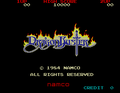
Title screen.
-
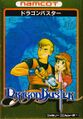
Famicom cover artwork.
-

MSX2 cover artwork.


