


| Pokémon Yellow | |
|---|---|
| Developer(s) | Game Freak |
| Publisher(s) | Nintendo |
| Year released | 1998 |
| System(s) | Game Boy, Nintendo 3DS |
| Preceded by | Pokémon Red and Blue |
| Followed by | Pokémon Gold and Silver |
| Series | Pokémon |
| Designer(s) | Satoshi Tajiri |
|---|---|
| Genre(s) | RPG |
| Modes | Single player, Multiplayer |
| Rating(s) |     |


Pokémon Yellow: Special Pikachu Edition is the fourth game in the Pokémon video game series in Japan, and the third in the rest of the world. It was released on the Nintendo Game Boy and features Super Game Boy and Game Boy Color enhancements. The game was released in Japan on September 12, 1998 and was simply known as Pocket Monsters Pikachu. It was released in North America on October 1, 1999 and was called Pokémon: Special Pikachu Edition by Nintendo. A digital re-release of Pokémon Yellow was launched on February 27, 2016 in the Nintendo 3DS e-Shop, for Pokémon's 20th anniversary of the original Japanese launch of the series on the original Game Boy. In both regions, the games are often referred to by fans as simply Pokémon Yellow or Pokémon Pikachu (though the latter name was officially assigned to the Pokémon Pikachu pedometer).
-
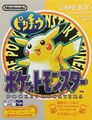
Japanese boxart for Pocket Monsters Pikachu.
-
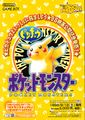
Japanese flyer for Pocket Monsters Pikachu front
-
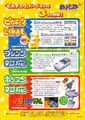
Japanese flyer for Pocket Monsters Pikachu back.


Gameplay[edit]
This version of Pokémon received its name due to the fact that Trainers get Pikachu as their starter Pokémon instead of being able to choose between Bulbasaur, Charmander, and Squirtle. You can, however, receive all three regular starters during the course of this game. Pokémon Yellow players can trade their Pokémon with the Red and Blue version players. They may also trade with Pokémon Gold, Pokémon Silver, and Pokémon Crystal. However, any of the 100 Pokémon introduced in those versions cannot be traded into Pokémon Yellow, just as they can't be traded into the Red or Blue versions.
The graphics are improved over the original Red and Blue games. Although it was released in Japan as a monochrome Game Boy game prior to the Game Boy Color, Yellow was colorized to a limited extent when it was released elsewhere. For example, the Pokémon's art is colored a single color for each Pokémon, and each city shades everything in its own particular tint. Because of the additional coloring beyond the usual single palettes of GB games when played on a GBC, this title actually acts as a dual mode Game Boy Color title (i.e., the default palette can't be changed at start-up), even though it was packaged as a monochrome Game Boy title.
Pokémon Yellow can be played on almost any variety of Game Boy, as well as the Super Game Boy (the Super Game Boy and Game Boy Color palettes are nearly identical) and the Game Boy Player. The only system it can't be played on is the Game Boy Micro. On the Nintendo 64, Pokémon Yellow can be played on the television through Pokémon Stadium and Pokémon Stadium 2 with the use of Nintendo 64 Transfer Pack. The Transfer Pack allowed the transfer of a player's Pokémon to the Nintendo 64 for three-dimensional battles and new features. Using the Yellow Pikachu in the Stadium games makes it sound like Pikachu from the Pokémon animé.